 |
There are currently, 240 guest(s) and 0 member(s) that are online.
You are Anonymous user. You can register for free by clicking here
| |
| |
'Juiced-up' Sugar-Fueled Battery Could Power Portable Electronics
Posted on Sunday, March 25, 2007 @ 15:26:29 UTC by vlad
|
|
 Juicing up your cell phone or iPod may take on a whole new meaning in
the future. Researchers at Saint Louis University in Missouri have
developed a fuel cell battery that runs on virtually any sugar source —
from soft drinks to tree sap — and has the potential to operate three
to four times longer on a single charge than conventional lithium ion
batteries, they say.
For consumers, that could mean significantly longer time to talk and
play music between charges. The new battery, which is also
biodegradable, could eventually replace lithium ion batteries in many
portable electronic applications, including computers, the scientists
say. Their findings were described today at the 233rd national meeting
of the American Chemical Society.
“This study shows that renewable fuels can be directly employed in
batteries at room temperature to lead to more energy-efficient battery
technology than metal-based approaches,” says study leader Shelley
Minteer, Ph.D., an electrochemist at Saint Louis University. “It
demonstrates that by bridging biology and chemistry, we can build a
better battery that’s also cleaner for the environment.”
Using sugar for fuel is not a new concept: Sugar in the form of
glucose supplies the energy needs of all living things. While nature
has figured out how to harness this energy efficiently, scientists only
recently have learned how to unleash the energy-dense power of sugar to
produce electricity, Minteer says.
A few other researchers also have developed fuel cell batteries
that run on sugar, but Minteer claims that her version is the
longest-lasting and most powerful of its type to date. As proof of
concept, she has used a small prototype of the battery (about the size
of a postage stamp) to successfully run a handheld calculator. If the
battery continues to show promise during further testing and
refinement, it could be ready for commercialization in three to five
years, she estimates.
Consumers aren’t the only ones who stand to benefit from this new
technology. The military is interested in using the sugar battery to
charge portable electronic equipment on the battlefield and in
emergency situations where access to electricity is limited. These
devices include remote sensors for detecting biological and chemical
weapons. Devices could be instantly recharged by adding virtually any
convenient sugar source, including plant sap, Minteer says.
Like other fuel cells, the sugar battery contains enzymes that convert
fuel — in this case, sugar — into electricity, leaving behind water as
a main byproduct. But unlike other fuel cells, all of the materials
used to build the sugar battery are biodegradable.
So far, Minteer has run the batteries on glucose, flat sodas,
sweetened drink mixes and tree sap, with promising results. She also
tested carbonated beverages, but carbonation appears to weaken the fuel
cell. The best fuel source tested so far is ordinary table sugar
(sucrose) dissolved in water, she says.
One of the first applications Minteer envisions for the sugar fuel
cell is using it as a portable cell phone recharger, similar to the
quick rechargers already on the market that allow users to instantly
charge their cell phones while ‘on the go.’ Ideally, these rechargers
would contain special cartridges that are pre-filled with a sugar
solution. These cartridges then could be replaced when they’re used up.
Ultimately, she hopes that the sugar battery can be used as a
stand-alone battery replacement in a wide range of portable electronic
devices.
Future work includes modifying the battery’s performance for
varying environmental conditions, including high temperatures, and
extending the life of the battery, Minteer says. Funding for this study
was provided by the U.S. Department of Defense.
Source: ACS
Via: http://www.physorg.com/news94043039.html
|
| |
|
Don't have an account yet? You can create one. As a registered user you have some advantages like theme manager, comments configuration and post comments with your name.
| |
Average Score: 5
Votes: 2

| |
|
| "'Juiced-up' Sugar-Fueled Battery Could Power Portable Electronics" | Login/Create an Account | 4 comments | Search Discussion |
|
| | The comments are owned by the poster. We aren't responsible for their content. |
|
|
|
No Comments Allowed for Anonymous, please register |
|
Flexible Battery Charges in a Minute (Score: 1)
by vlad on Sunday, March 25, 2007 @ 15:35:46 UTC
(User Info | Send a Message) http://www.zpenergy.com | 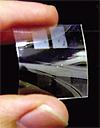 Scientists at Japan's Waseda University have developed a new new
polymer-based battery, which not only charges in less than a minute,
but also lasts for up to 1,000 recharges. The cool thing about the
superthin (200nm-thick to be exact) battery is that unlike previous
polymer-based batteries, this one won't won't self-discharge.
The battery – which consists of a redox-active organic polymer film around 200 nanometres thick. Nitroxide radical groups are attached, which act as charge carriers. Because of its high radical density, the battery has a high charge/discharge capacity. This is just one of many advantages the ‘organic radical’ battery has over other organic based materials according to the researchers. The power rate performance is strikingly high – it only takes one minute to fully charge the battery and it has a long cycle life, often exceeding 1,000 cycles. The team made the thin polymer film by a solution-processable method – a soluble polymer with the radical groups attached is “spin-coated” onto a surface. After UV irradiation, the polymer then becomes crosslinked with the help of a bisazide crosslinking agent.
Story Via http://www.keelynet.com/#whatsnew [www.keelynet.com]
|
|
|
New 'biofuel cell' produces electricity from hydrogen in plain air (Score: 1)
by vlad on Monday, March 26, 2007 @ 22:33:02 UTC
(User Info | Send a Message) http://www.zpenergy.com | A pioneering “biofuel cell” that produces electricity from ordinary air
spiked with small amounts of hydrogen offers significant potential as
an inexpensive and renewable alternative to the costly platinum-based
fuel cells that have dominated discussion about the “hydrogen economy”
of the future, British scientists reported here today.
Full story: http://www.physorg.com/news94144517.html [www.physorg.com]
|
|
|
|
|


